CHOI KEYOUNG MOOK
The Line as Breath
For more than twenty years, I have explored the line as the central language of my artistic practice. For me, a line is not simply a boundary or a visual mark. It is a trace of movement, a record of time, and a form of breathing. It carries the presence of the body and reveals the energy of the moment in which it is made.
My understanding of the line has been shaped by long-term practice in calligraphic creation and by my study of art at Shanghai University, where I continued to investigate the aesthetic and expressive possibilities of the line. Through this process, I have come to see the Eastern line not as a fixed tradition, but as an open and living language that can move naturally into contemporary abstraction.
Eastern Aesthetics and Contemporary Abstraction
I am interested in the space between control and release. A brushstroke begins with intention, but its final form is also shaped by speed, pressure, rhythm, ink or paint, and the resistance of the surface. I allow these physical elements to remain visible. Rather than hiding the process, I consider the trace of the gesture to be an essential part of the work.
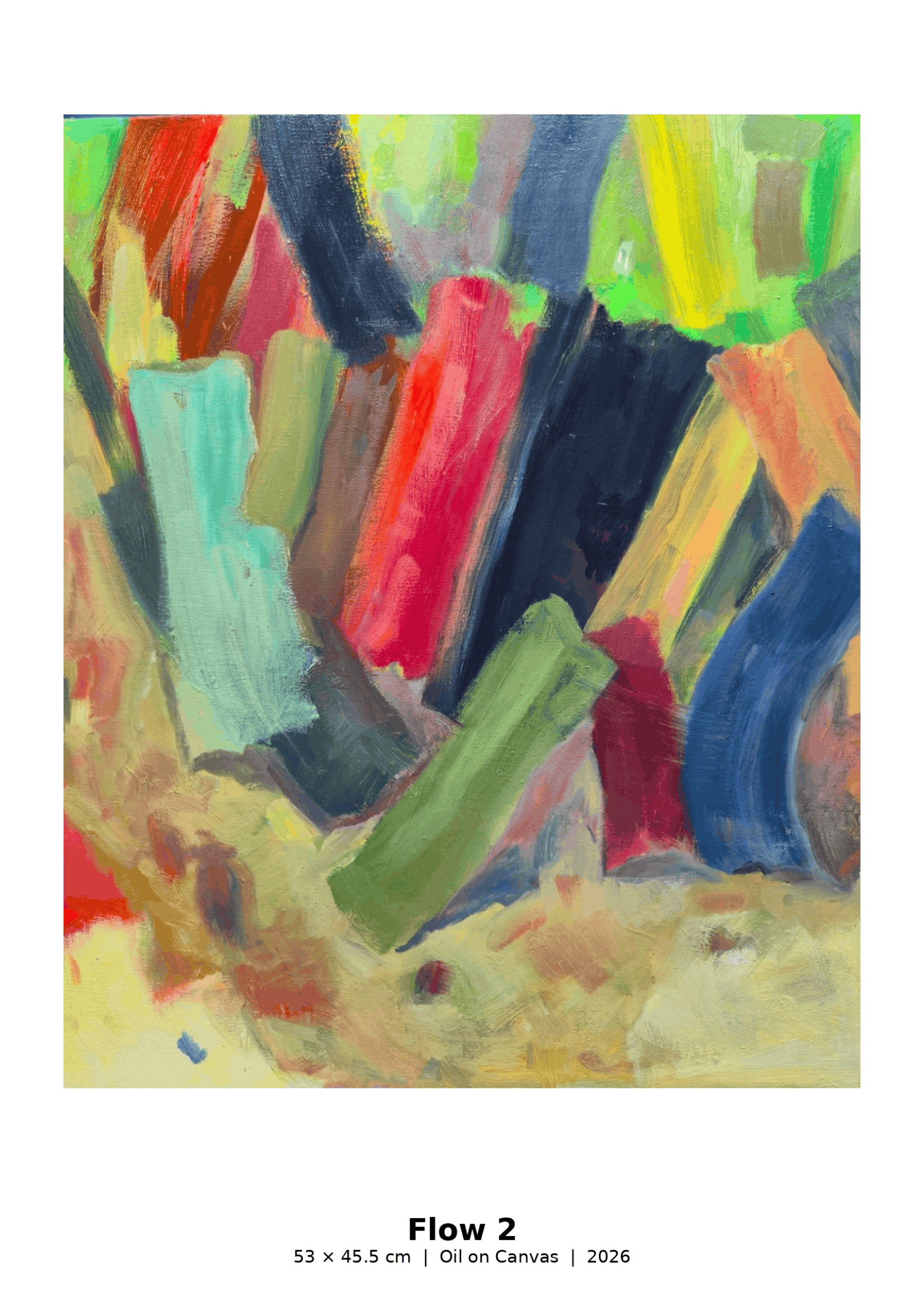
My paintings combine the aesthetic sensibility of the Eastern line with the openness of contemporary abstraction. Color can become energy; ink can become density and silence; repetition can become rhythm; and empty space can become an active part of the composition.
The image is therefore not intended to represent a specific object. It is intended to make movement and inner rhythm perceptible.
Breath, Movement and Space
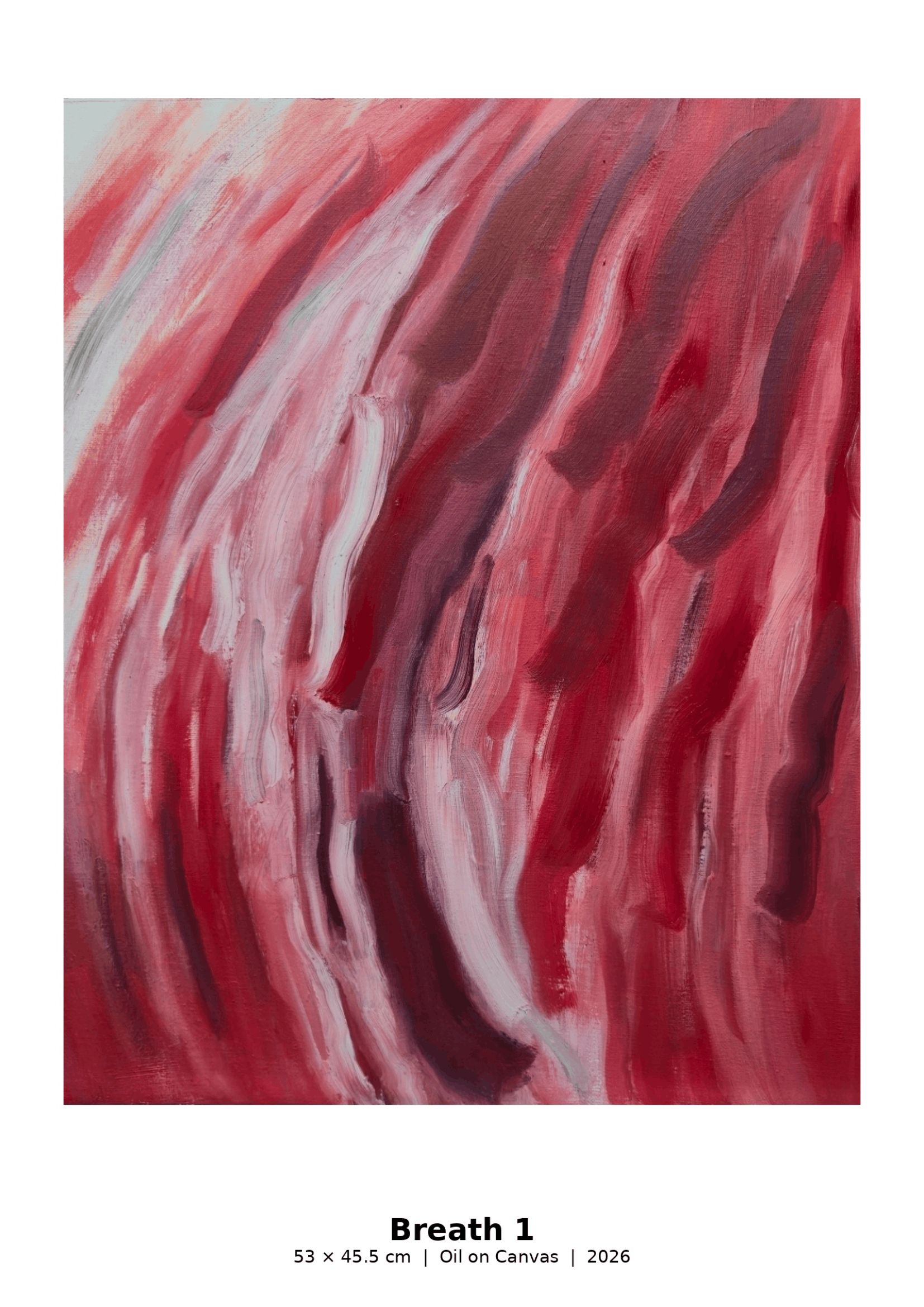
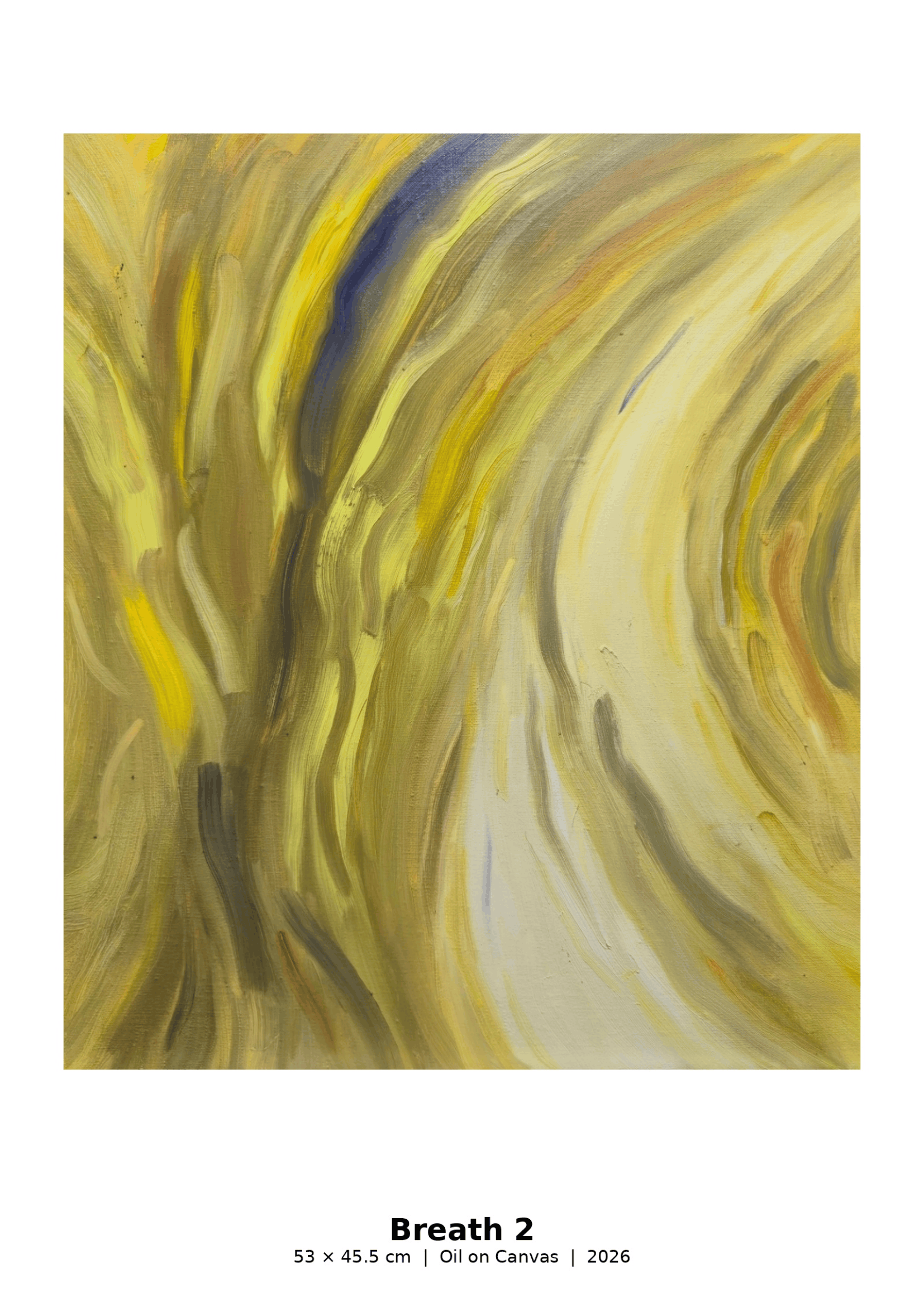
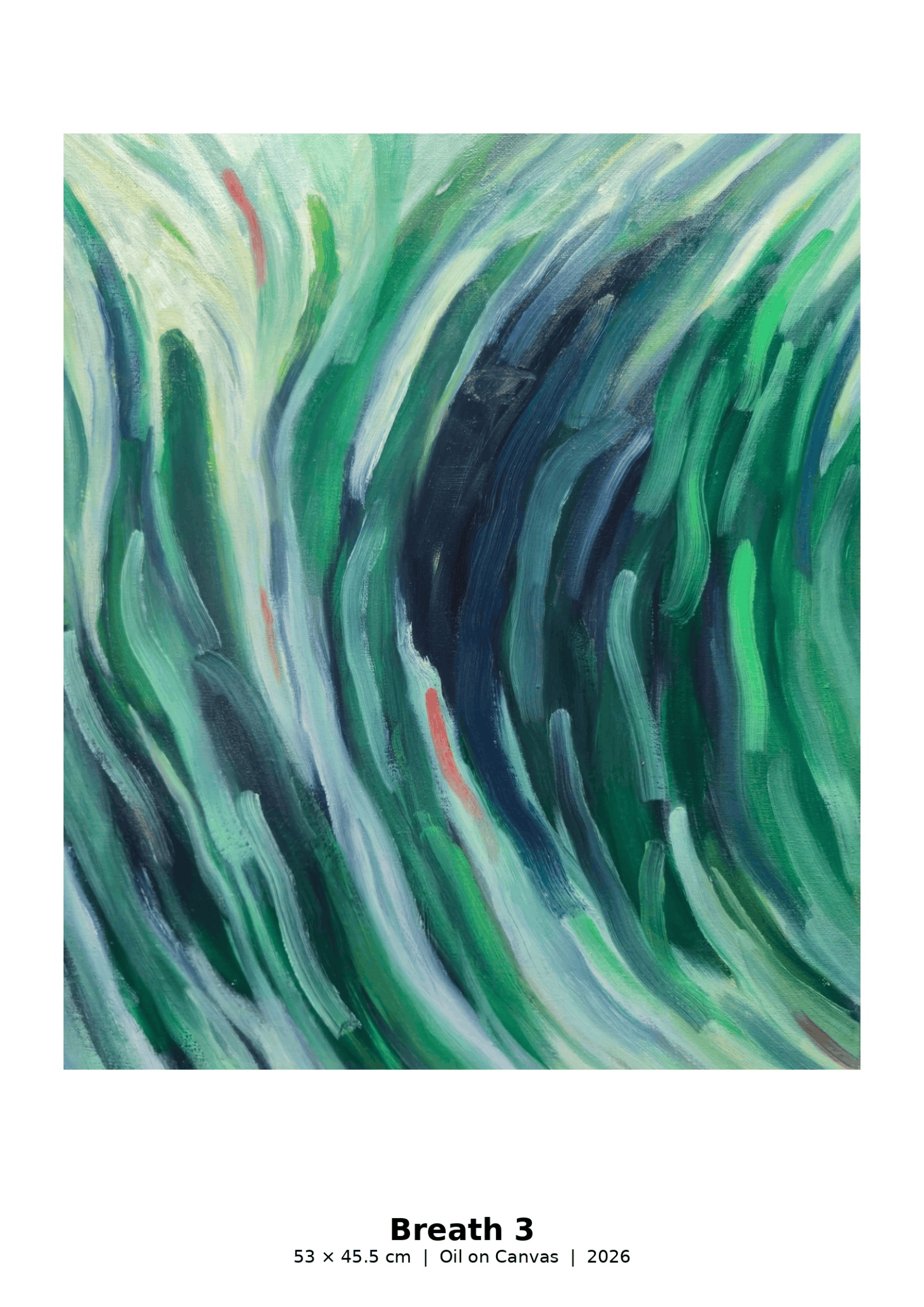
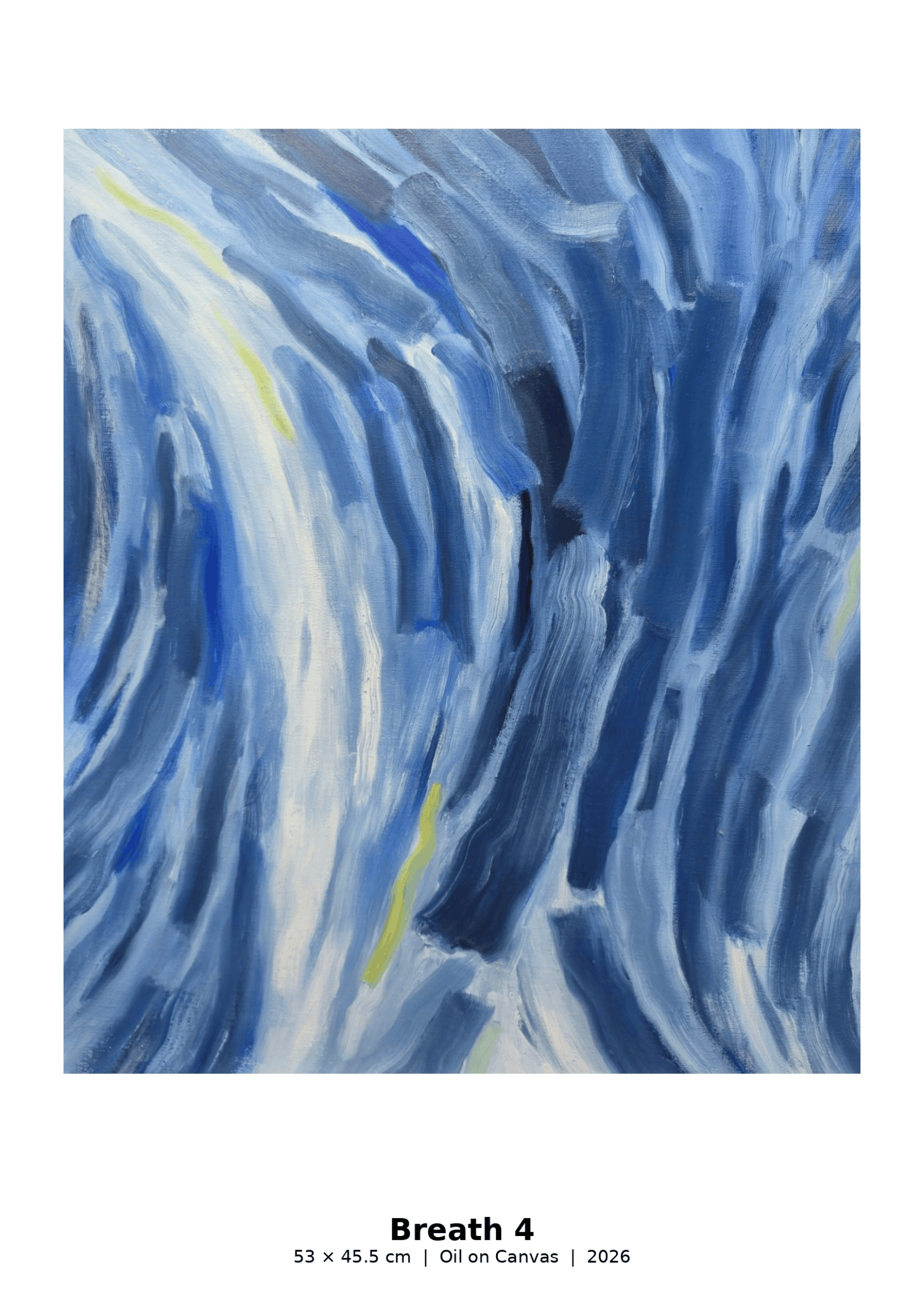
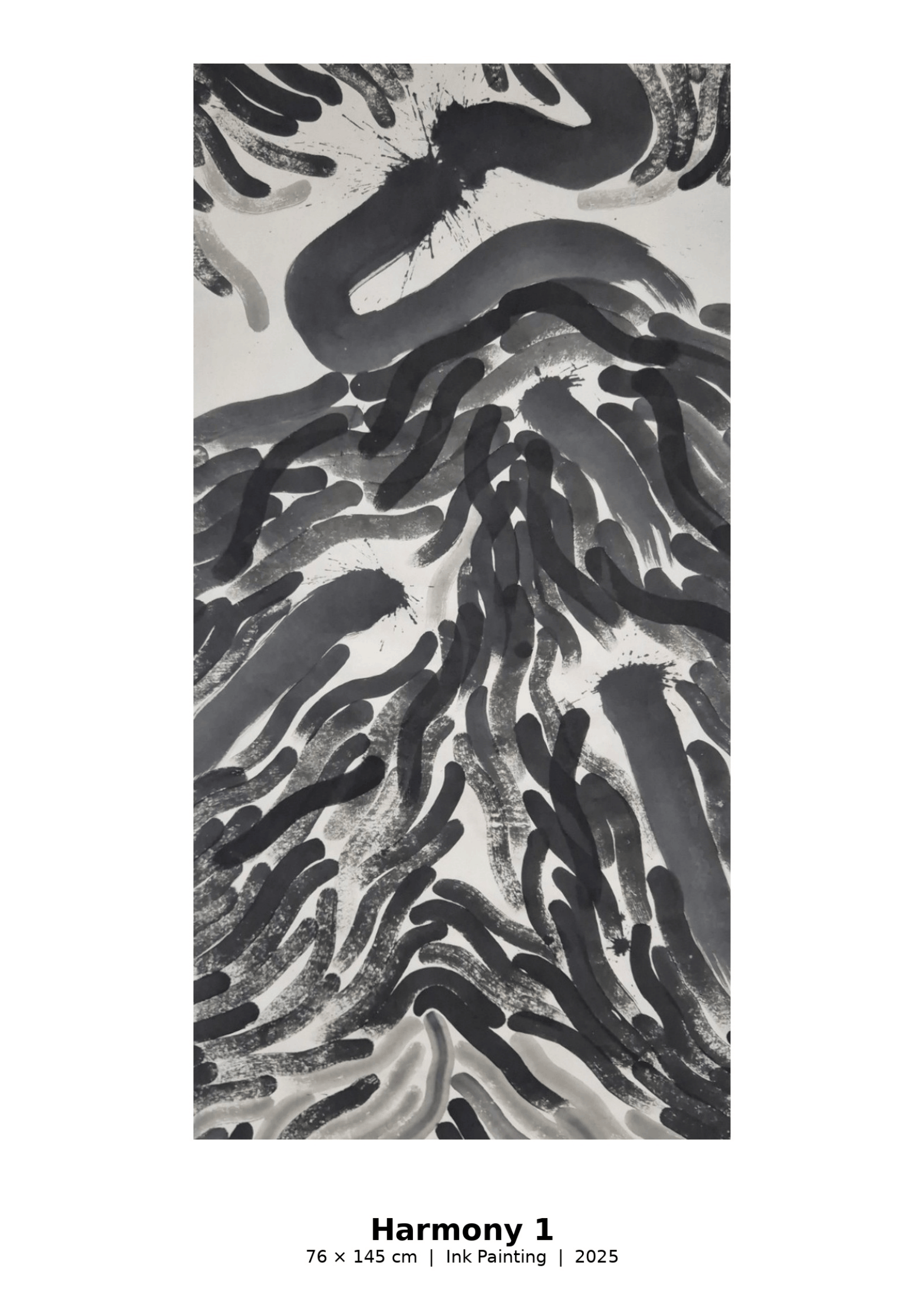
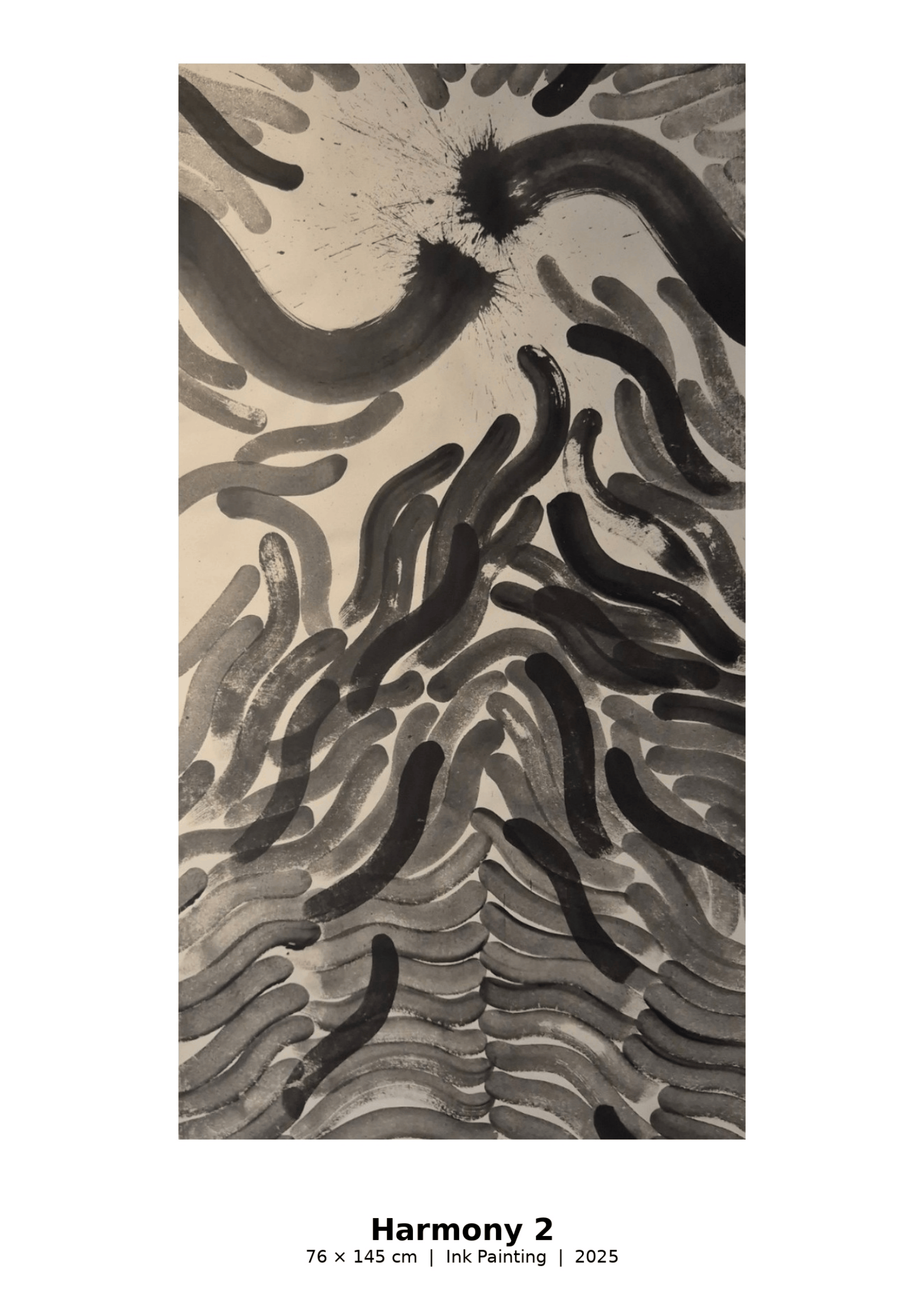
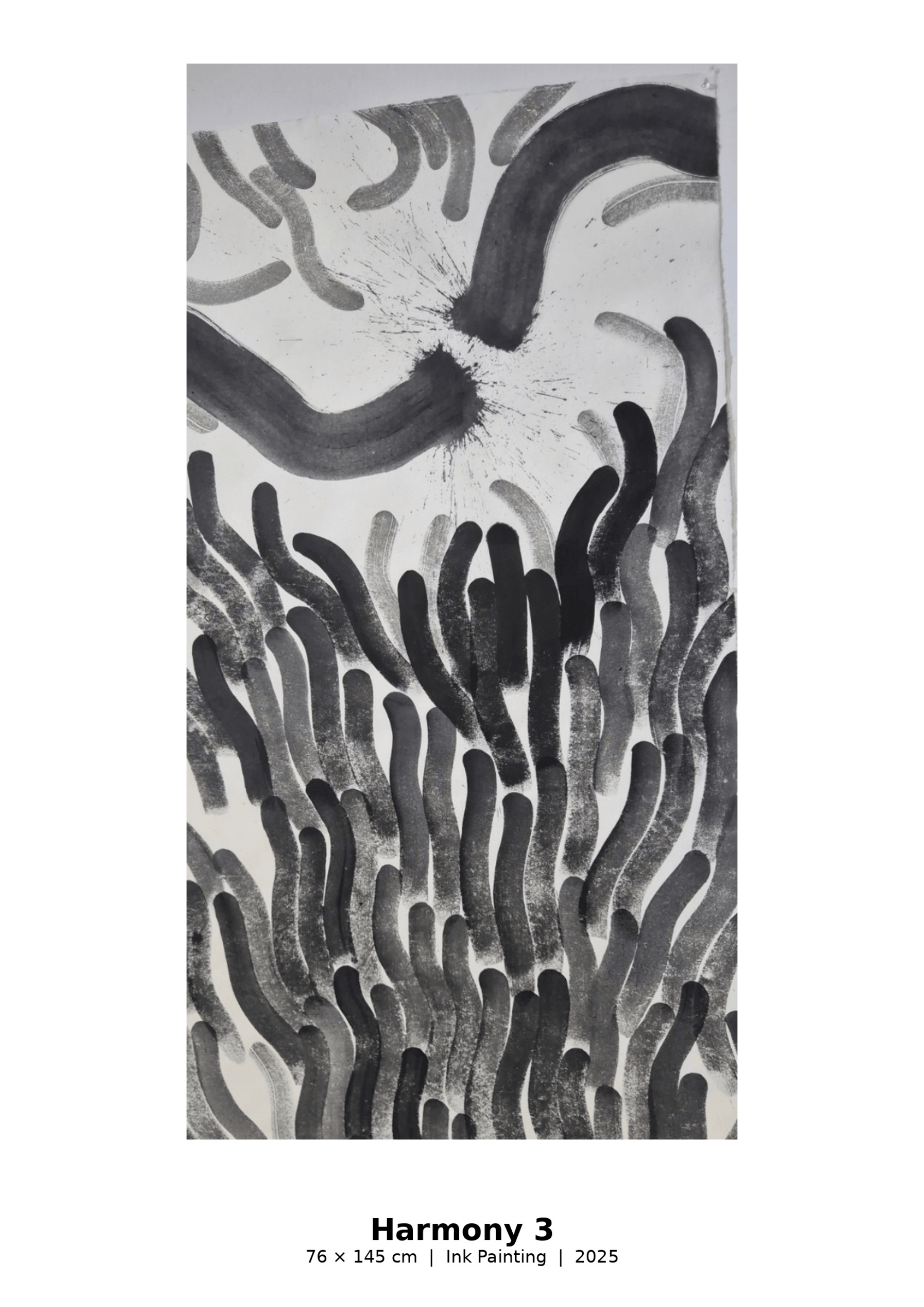
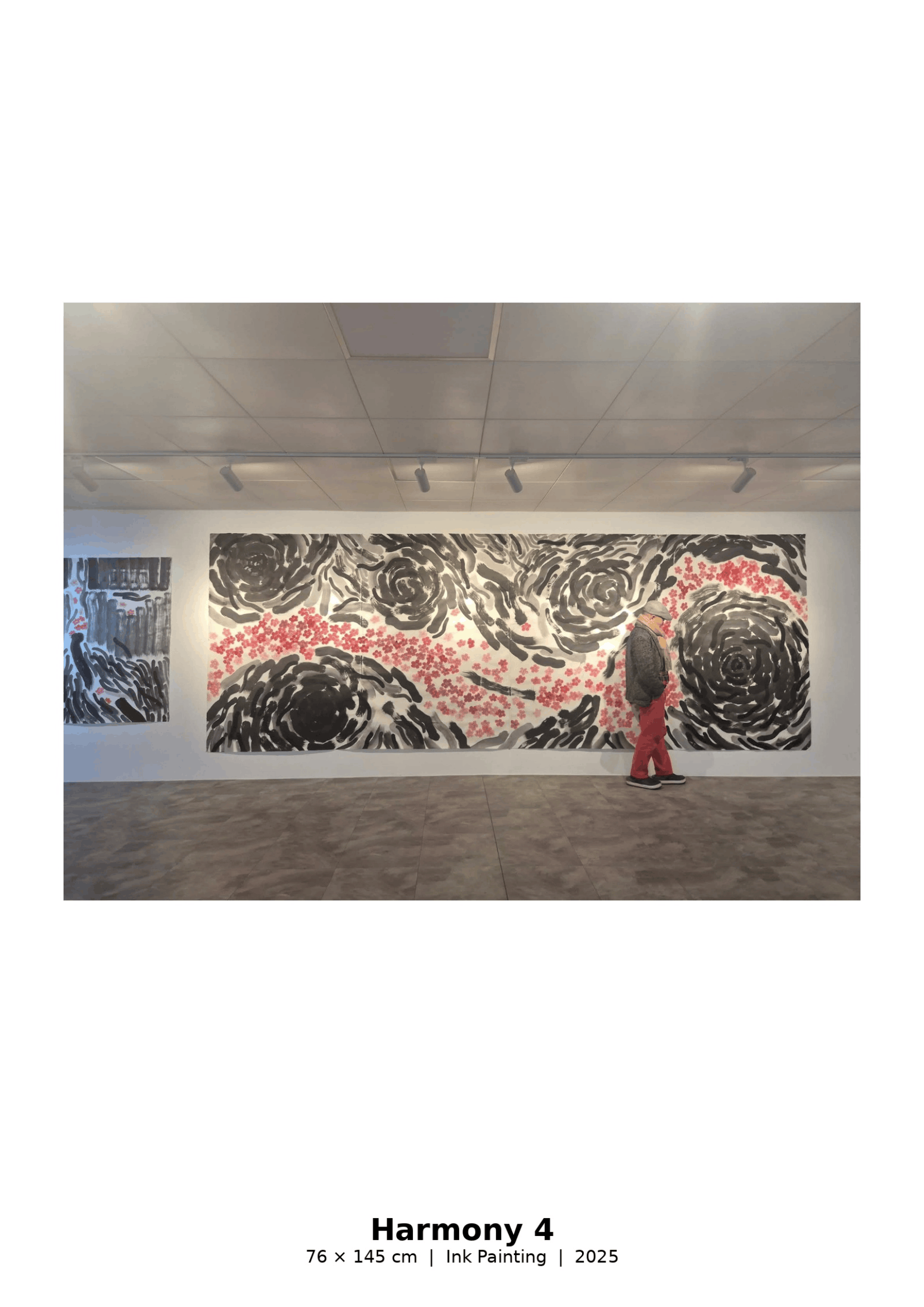
The Gyeol series develops this idea through flowing lines and color. Each work is conceived as a visual rhythm that expands and contracts like breathing. Flow and Harmony continue the investigation by examining how individual gestures can move through a larger field and coexist within a sense of balance.
In my ink paintings, the line becomes more direct and physical. The absence of color places greater emphasis on brush pressure, density, speed, interruption and the space between strokes.
In large-scale works such as Movement, the line extends beyond the intimate scale of the body and enters architectural space. The gesture becomes an environment rather than merely an image.
My Artistic Direction
I continue to pursue one fundamental question:
How far can a single line speak?
I want my paintings to remain open enough for viewers to experience their own rhythm, movement and emotion. The meaning of the work is not completed by the artist alone; it is completed through the encounter between the mark and the viewer.
I call myself The Artist of Lines because the line has been the continuous thread connecting my research, my calligraphic practice and my painting.
Through the line, I seek to transform breath into movement, movement into rhythm, and rhythm into space.
“The line is the trace of a breath moving through time.”
CHOI KEYOUNG MOOK
The Artist of Lines
Social Networks :
Instagram handle: @kmook82
CHOI KEYOUNG MOOK
1. Inspiration & Style
What initially inspired you to become an artist, and how did you develop your unique artistic style?
My journey as an artist began unexpectedly when I was in the sixth grade of elementary school. My father was a carpenter who made wooden forms for apartment construction. One day, I secretly took a saw that he had told me not to touch and made a small desk with two drawers. That experience of creating something with my own hands became the beginning of my artistic life.
As a teenager, I dreamed of becoming a writer because I loved literature and reading. However, after receiving second prize in a school art competition, my art teacher encouraged me three times to pursue art. Eventually, I gave up my dream of becoming a writer and chose the path of an artist.
During my university years, I became fascinated by abstract art and studied the works of artists such as Kim Whanki, Piet Mondrian, Mark Rothko, Anselm Kiefer, Frank Stella, and Ellsworth Kelly. I also explored Surrealism and figurative painting.
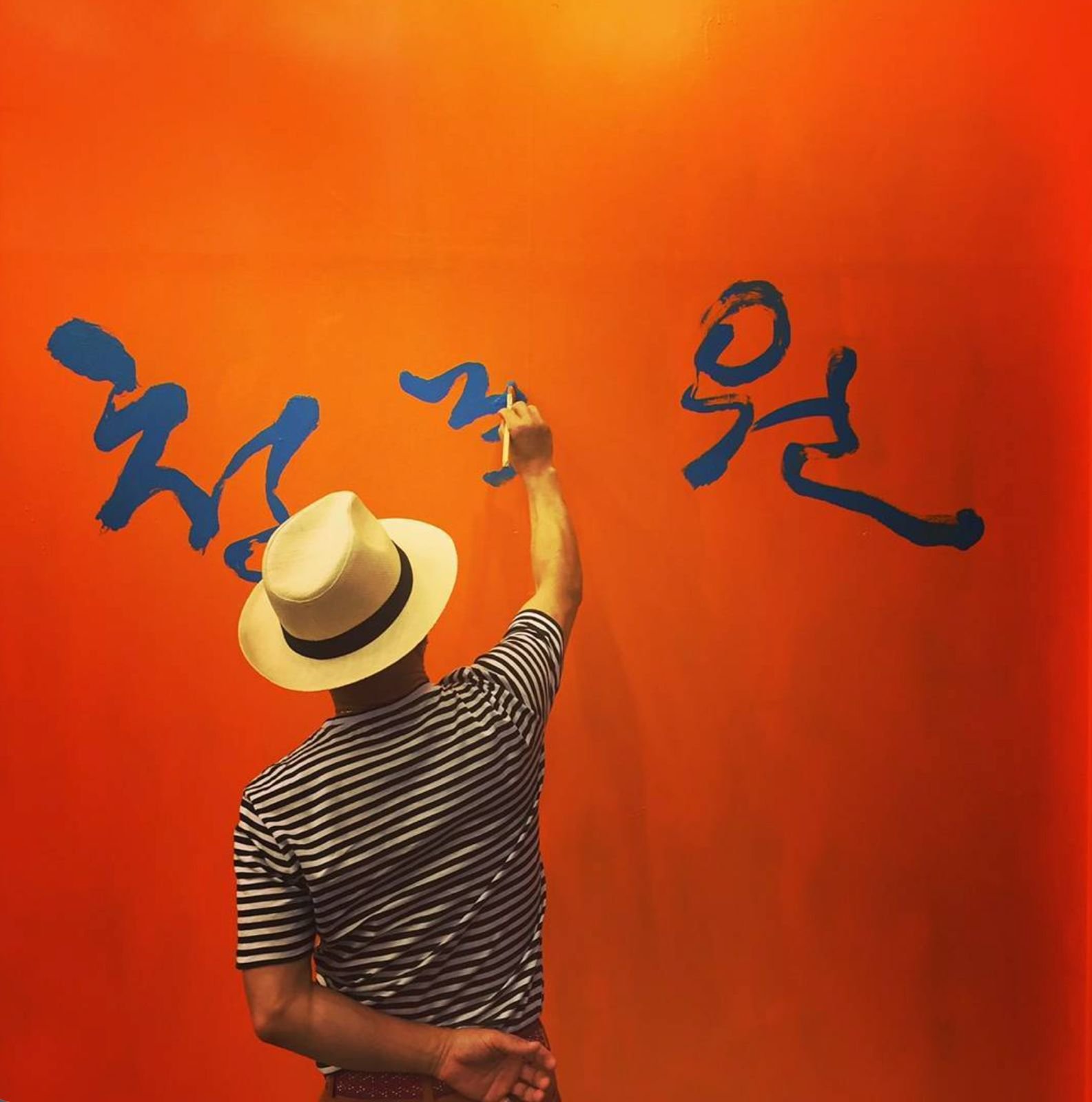
A major turning point came when I began studying calligraphy in my thirties. Through many years of practicing traditional Korean and Chinese calligraphy, I gradually discovered the expressive power of the line. Since then, the line has become the central language of my art.
I have continued to move freely between painting, sculpture, calligraphy, and ink painting. Today, I combine the spirit and discipline of calligraphic lines with abstraction, ink, color, and movement. I am constantly exploring how a single line can contain energy, emotion, rhythm, and life.
2. Creative Process
Do you have any rituals or routines that help you get into a creative mindset when starting a new project?
For many years, I have started my day by practicing calligraphy. This daily practice has become more than a routine; it is a way of preparing my mind and body for artistic creation.
Before beginning a new painting, I often observe lines around me and think about their movement, rhythm, tension, and balance. I have accumulated more than ten sketchbooks filled with studies of lines, movements, and ideas, and these sketchbooks have become an important source for my paintings.
When I paint, I try not to control every movement consciously. I allow the line to move naturally and respond to the moment. In some works, a single brushstroke is made quickly and only once. The physical movement of my body becomes part of the painting.
For me, the act of painting is not simply applying ink to a surface. It is a process in which the body, mind, brush, ink, and moment come together.
3. Artistic Influences
How do you balance historical or artistic influences with your personal style, and how do these influences manifest in your work today?
I have always believed that an artist must learn from the past while continuing to search for his or her own language.
Calligraphy has had the greatest influence on my artistic development. I studied Korean and Chinese calligraphy, practiced the five traditional styles of Chinese calligraphy, and later studied Chinese painting and ink painting more deeply.
In 2013, I went to China to study at the Graduate School of Fine Arts at Shanghai University. I completed my master's degree in 2016. During this period, I concentrated on an important question: What is a line?
My graduate research allowed me to examine the nature, movement, rhythm, and expressive possibilities of the line. I also presented research on creative methods through the study and reinterpretation of traditional works. This experience helped me understand that studying tradition does not mean simply reproducing it; it can become a foundation for creating something new.
My experiences with Western modern art also influenced me greatly. During my stay in New York, I visited MoMA, the Whitney Museum, the Guggenheim, and many other museums and galleries. These experiences helped me understand contemporary art from a broader perspective.
However, my ultimate goal has always been to transform these influences into my own visual language. Today, I see the line not simply as a formal element, but as a living force.
4. Emotion & Expression
How do you use your art to evoke emotions, and what role does emotion play in your creative process?
Emotion is at the heart of my work.
For me, a line is not merely a mark on a surface. It can breathe, move, tremble, accelerate, slow down, gather, separate, and disappear. Through these qualities, I try to express the energy and rhythm of life.
Sometimes I use only a few powerful lines to create a sense of speed, movement, and vitality. In other works, I bring together different lines—thick and thin, long and short, dark and light—to explore harmony and the relationships between individual elements.
I am particularly interested in the relationship between movement and stillness. A painting may appear quiet, yet the lines can contain tremendous internal energy.
My intention is not to tell viewers exactly what they should feel. I want the painting to create a space where each viewer can experience their own emotions, memories, and interpretations.
5. Standout Projects
Can you share a project that stands out to you and describe the creative process behind it?
One of the most important projects in my artistic journey was my long-term exploration of the human thumb.
In 1988, I encountered a monumental sculpture by César at Olympic Sculpture Park in Seoul. I was deeply impressed by its enormous scale, but at the same time I wondered why the form felt so rigid. I began thinking about how I could create something softer and more human.
I bought clay for terracotta and began making thumbs. I observed the thumbs of many different people, from children to elderly people, paying attention to their shapes, gestures, age, and traces of everyday life.
I eventually developed my own surreal interpretation of the human thumb. One of these works, A Thumb Resembling a Human Being, received an award in the sculpture category of the Gyeonggi Art Exhibition.
Another important sculpture project, In Yeon, combined an animal-like form inspired by pine trees and tree bark with the shape of a thumb. This work received a Special Award at the Ansan International Art Fair.
These experiences taught me something important: an ordinary object can become a powerful artistic subject when we look at it deeply enough.
They also helped me realize that my artistic identity did not have to belong to only one medium. I could move freely between sculpture, painting, calligraphy, and ink painting while continuing to search for my own artistic language.
6. Feedback & Growth
How do you incorporate feedback from critics or audiences into your work, and how do you balance this with your own artistic intuition?
I respect criticism and the opinions of viewers, but ultimately I believe that an artist must remain true to his or her own artistic intuition.
Throughout my career, I have received encouragement, criticism, awards, and opportunities to exhibit both in Korea and internationally. Since my first solo exhibition in 2002, I have continued to develop my work through numerous solo and group exhibitions.
I have learned from every experience, but I have never wanted external opinions to determine the direction of my work.
The most important question for me is always:
“What am I trying to discover through my art?”
I believe an artist must continue to question, experiment, fail, learn, and move forward. My own artistic language has developed through this continuous process.
7. Motivation & Inspiration
How do you stay motivated and inspired, even when facing creative blocks or challenges?
When I feel uncertain about my work, I return to observation and research.
I visit museums and exhibitions, study the work of other artists, read, draw, practice calligraphy, and return to my sketchbooks. Sometimes a completely unexpected image or line becomes the starting point for a new work.
My international exhibition experiences have also continued to broaden my perspective. Exhibiting in New York in 2015, Venice in 2017, and France in 2019 gave me opportunities to encounter different artistic environments and audiences.
I have learned that creative blocks are not necessarily negative. They can be a period of preparation.
For me, the most important thing is to remain curious. As long as I continue asking questions, I believe there will always be another line to draw and another possibility to discover.
8. Exhibiting Work
How do you feel about exhibiting your artwork with The Holy Art Gallery, and what does this opportunity mean to you?
I am very pleased and honored to have been selected to exhibit with The Holy Art Gallery.
My journey of solo exhibitions began in 2002, and I have continued to develop my work through ten solo exhibitions and numerous group exhibitions. My solo exhibitions have taken place in Korea as well as internationally, including New York in 2015, Venice in 2017, and France in 2019.
My most recent milestone was my tenth solo exhibition in 2025, where I presented large-scale works, including a 520-ho work measuring 212 × 535 cm, as part of my continuing exploration of the line.
For me, an international exhibition is more than an opportunity to display paintings. It is an opportunity to communicate with people from different cultural backgrounds through art.
For many years, I have devoted myself to exploring the possibilities of the line, beginning with the tradition of calligraphy and developing it into my own contemporary abstract language.
I hope this exhibition will allow more international viewers to encounter my work and experience the energy, rhythm, and emotions contained within my lines.
I would also like this opportunity to contribute to a broader understanding of the beauty and creative possibilities of the Asian line in contemporary art.
9. Future Goals
What are your long-term goals and aspirations as an artist, and how do you plan to achieve them?
My greatest goal is simple: I want to continue exploring the line.
I have spent many years studying calligraphy, ink painting, abstraction, sculpture, and contemporary art. In particular, through my practice of calligraphy and my graduate studies at Shanghai University, I developed a deep interest in wave-like lines, exploring their rhythm, movement, continuity, and expressive possibilities.
I became increasingly interested in how a flowing line can resemble the movement of waves, the rhythm of breathing, and the continuous flow of life. I continued to question what such lines could express and how they could become an independent artistic language.
The results of this long process of research and contemplation have gradually developed into my ongoing “Breath” series.
In these works, the line is not simply a visual mark. It represents breathing, movement, energy, and the continuous rhythm of life.
For me, the Breath series is not the conclusion of my research, but another beginning. I believe there are still countless possibilities within the line, and my exploration of it will continue.
I have already had opportunities to present my work internationally, but I want to continue expanding my artistic world through larger works, new experiments, and international exhibitions.
I want to develop a more distinctive and powerful language of line and share my interpretation of the line with a wider audience around the world.
I do not want to simply repeat what I have already achieved. I want each new work to become another question, another experiment, and another step forward.
My journey with the line is still in progress. I will continue to study, experiment, and discover the infinite possibilities of the line.
10. Audience Connection
What do you hope viewers take away from experiencing your art, and how do you aim to connect with them on an emotional or intellectual level?
I hope viewers can feel something before they try to explain what they are seeing.
A line can be simple, but it can also contain movement, tension, silence, energy, and emotion. I want viewers to experience these qualities directly.
My paintings do not necessarily represent a specific object or story. Instead, they invite viewers to create their own interpretation.
After more than twenty years of focusing on solo exhibitions and developing my work across painting, sculpture, calligraphy, and ink painting, I have come to believe that art does not always need to provide an answer. Sometimes it is more meaningful when it leaves a question in the mind of the viewer.
I hope someone standing in front of my work might feel the movement of life, the rhythm of nature, or even something within themselves that they cannot easily put into words.
For me, that is the true power of abstract art.
I am an artist who uses the line, rooted in the spirit of calligraphy, to explore movement, energy, harmony, and life. My wish is to continue discovering the infinite possibilities of the line and to share its value with the world.