ARTIST STATEMENT:
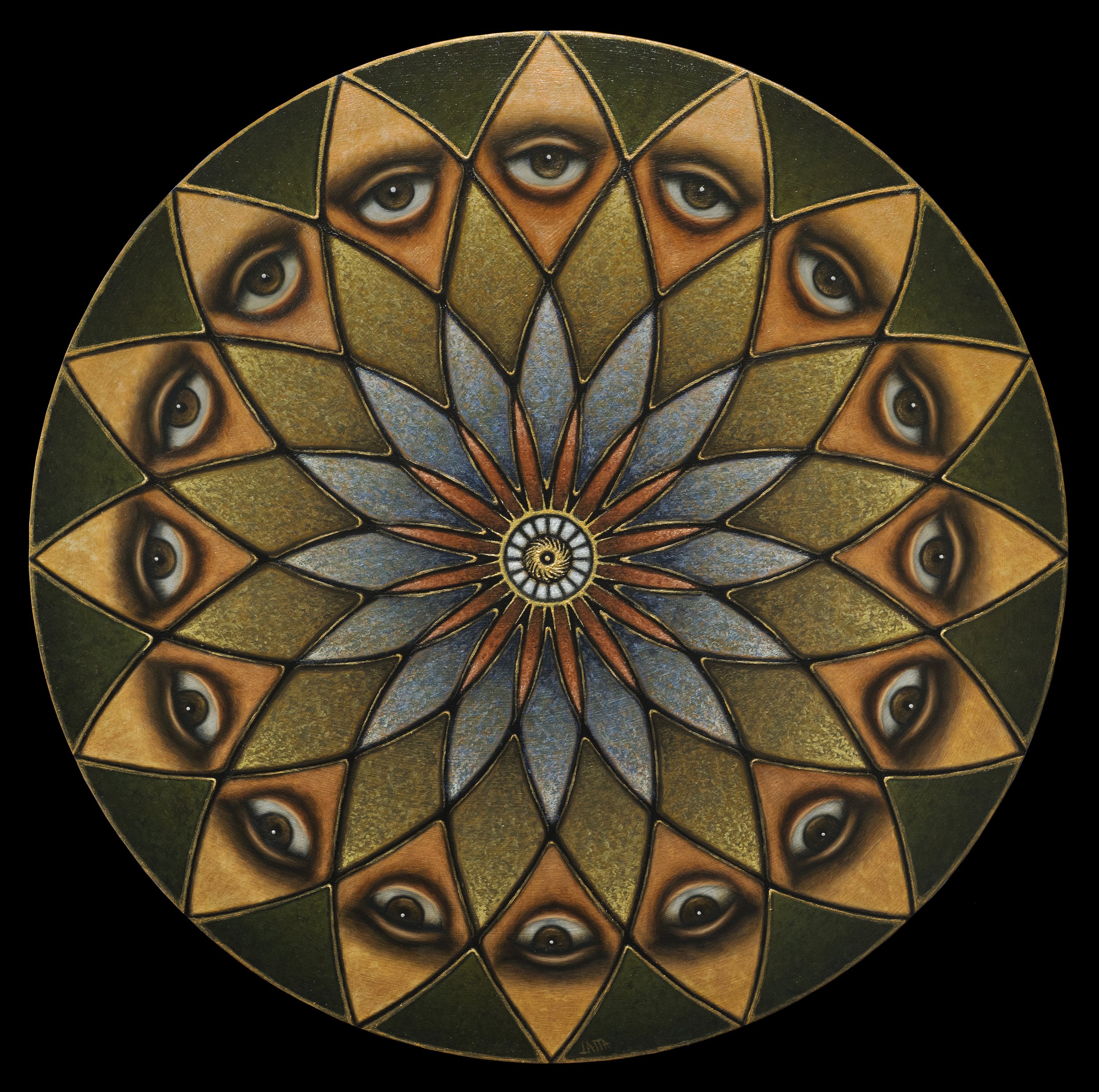
My paintings investigate the hidden architecture through which consciousness and reality reveal their underlying order. Drawing from altered states of consciousness, contemplative mysticism, philosophy of mind, and the physical sciences, my work investigates how inner experience can be given tangible form. These disciplines each attempt, in their own way, to approach the nature of reality, and my paintings exist where their questions begin to overlap.
I make this work because painting offers a unique way of communicating experiences that resist ordinary language. These experiences often reveal themselves as archetypal forms, luminous geometries, and patterns of profound coherence. I am less interested in depicting literal experience than in exploring the architecture through which perception, meaning, and consciousness emerge.
My process combines careful observation, symbolic research, and traditional methods of painting to build geometric structures, natural forms, sacred symbols, and recurring archetypes composed with an emphasis on balance, proportion, and craftsmanship. Classical painting provides a stable framework through which fleeting, immaterial experiences can be held and made enduring.
Whether the viewer interprets the paintings through spirituality, philosophy, psychology, or science, if the work succeeds it leaves the viewer with a sense of wonder and the possibility that the visible world is only one aspect of a far richer and more interconnected order.
Social Networks :
Instagram Handle: @steve.painting.perception
Website: https://stevelatta.com/
Portfolio: https://stevelatta.com/selected-works

Steven Latta
1. Inspiration & Style
What initially inspired you to become an artist, and how did you develop your unique artistic style?
I started making art when I was very young. I was always drawn to making images and creating things, long before I had any real concept of what it meant to be an artist. There was something about taking an idea or something imagined and giving it physical form that fascinated me. As I grew older, that impulse never really went away and it became clear art could be a vessel for so many things.
Over time, I became increasingly interested in consciousness, perception, mysticism, philosophy, and the nature of reality. Experiences with altered states of consciousness were particularly influential and introduced me to a visual world of archetypal forms, inner light, geometry, and imagery that’s incredibly vivid, but difficult to communicate through language. Painting gradually became a way of translating those experiences and ideas into something tangible. My style has ultimately emerged from bringing those different worlds together: the mystical and the physical, intuition and order, abstraction and representation.
My style developed through trying to reconcile visionary experience with my equally strong attraction to structure, precision, craftsmanship, and classical painting. I’ve always admired the rigor of classical painting and I became interested in using that tradition as a kind of vessel for imagery that originates outside of the classical world.
2. Creative Process
Do you have any rituals or routines that help you get into a creative mindset when starting a new project?
I wouldn’t say that I have a ritual in the traditional sense. The closest thing I have to one is the preparatory process itself. A painting usually begins with a vision or mental image, which I translate into a rough sketch. From there, I begin researching and developing each of the visual elements that will eventually make up the picture. I plan my paintings extensively, so there is a gradual process of moving carefully through each component until I feel that I understand the image well enough to begin painting.
As far as mindset I’m looking for a kind of even-minded balanced state of mind where I’m focused and attentive without trying to force anything and my studio itself reflects that same desire for balance. I work in solitude, with bright natural light, ambient music, and usually coffee. It's important to have a quiet ordered environment.
3. Artistic Influences
How do you balance historical or artistic influences with your personal style, and how do these influences manifest in your work today?
I think originality often comes through synthesis, through absorbing many different traditions, ideas, and experiences and allowing them to combine into something that reflects your own way of seeing. Historically, I’m deeply influenced by the Renaissance and Northern Renaissance, as well as symbolist, sacred, and visionary art. Artists as varied as Leonardo da Vinci, Raphael, Jan van Eyck, William-Adolphe Bouguereau, Andrew Wyeth, Hilma af Klint, and Alex Grey have all influenced different aspects of how I think about image making. What I take from them varies considerably: composition, technique, perspective, iconography, color design, surface treatment, technical precision, etc.
In a broad sense, I consider what I make to be religious art. I’m interested in the historical function of sacred imagery as a bridge between material and immaterial worlds. With Hilma af Klint, for example, I’m influenced both by her visual language and by her conviction that abstraction and symbolic form could describe aspects of reality that cannot be directly observed. At the same time, I’m drawn to the extraordinary material precision of artists like van Eyck and the Renaissance painters. Those influences might seem to pull in opposite directions, but bringing them together is central to my work.
Ultimately, I think my personal style emerges from the process of integrating all of these elements rather than trying to separate myself from them. By the time they have passed through the process of integration and have been filtered through my own psyche the result feels distinctly my own.
4. Emotion & Expression
How do you use your art to evoke emotions, and what role does emotion play in your creative process?
Emotion plays an important role in my work, but I don’t necessarily think of my painting as a means of expressing personal emotion. I’m more interested in the transcendent and creating the conditions for that experience in the viewer. The initial visions or mental images that inspire the paintings are often accompanied by a feeling of awe or divinity. Part of the creative process is trying to preserve something of that original feeling as the image moves from an internal experience into a physical object. The process itself is disciplined and deliberate, and I’m usually trying to maintain the even-minded state I described earlier. That said, I'm constantly sensitive to whether the image is becoming more beautiful and whether it is retaining the sense of presence that originally compelled me to make it. Beauty is of the highest importance to me. I think it has the capacity to draw us beyond ourselves. Historically, sacred art has used beauty to direct attention toward something transcendent, and I’m interested in continuing that tradition in a contemporary way.
5. Standout Projects
Can you share a project that stands out to you and describe the creative process behind it?
One project that stands out to me is my painting Prime Movement No. 3, which I consider my most mature work to date. The painting began with an altered-state experience in which I encountered what I perceived as a divine form presenting as a triangular shape emanating creation. The challenge became finding a way to give that experience a concrete visual form without losing the sense of divinity that made it significant in the first place. From that initial vision, I began a long process of research and development. I looked at artists such as Hilma af Klint, as well as religious and esoteric symbolism, diagrams from physics, and patterns found in nature. I was particularly interested in forms that seem to embody processes of creation and emergence—fractal and recursive structures, flowers, geometry, and patterns that repeat across different scales of the natural world. The painting evolved considerably during its development. A vision can exist internally without having to obey the rules of a physical image, but the moment you attempt to make it concrete, it becomes subject to composition, proportion, perspective, color, material, and all of the limitations and possibilities of visual design. There was a constant negotiation between remaining faithful to the essence of the original experience and allowing the painting to become a successful object in its own right. In some ways, that process of translation is at the heart of my entire practice. The painting ultimately took more than 600 hours to complete. Much of the challenge was simply pushing myself technically—developing my craft as a painter while also deepening my understanding of visual design.
6. Feedback & Growth
How do you incorporate feedback from critics or audiences into your work, and how do you balance this with your own artistic intuition?
I try to take in and consider all criticism, but I draw a distinction between feedback about how I make the work and the deeper question of what work I choose to make. The direction of my practice is determined by my own experience and intuition. Almost everything else, however, is open to reconsideration. I’m particularly interested in criticism concerning technique, visual design, and workflow. I tend to seek feedback only after I’ve taken a painting as far as I possibly can on my own. I want to fully exhaust my own knowledge and intuition first, because I think there is value in struggling with the problems of a painting independently. Once I reach the limits of what I can see or solve myself, another artist’s perspective can become valuable in helping to see with fresh eyes. Sometimes the most useful criticism is unexpected and forces me to reconsider an assumption I didn’t even realize I was making. Being receptive means being willing to genuinely consider another perspective before deciding whether it belongs in the work. Ultimately, I think of criticism as a tool for expanding my awareness rather than directing my practice. I want to remain as open as possible to anything that can make me a better painter, while preserving the internal compass that tells me what paintings need to exist in the first place.
7. Motivation & Inspiration
How do you stay motivated and inspired, even when facing creative blocks or challenges?
My relationship to making art is some combination of obsession, calling, spiritual practice, and a search for Truth. Because of that, I work every day regardless of how I feel. Inspiration may initiate a painting, but it isn’t what carries me through the hundreds of hours required to finish one. Over the long term, I’m motivated by the reward of difficult learning, the pursuit of excellence, and a genuine obsession with the work itself. I find it deeply engaging to encounter the limits of my ability and then work toward extending them. There is always a gap between what I envision and what I’m currently capable of making and I find that enormously motivating. I feel that I’ve only achieved a portion of what I’m capable of, and discovering what lies beyond my present abilities is one of the things that keeps me motivated and inspired each day. In a sense, a block becomes another problem to study and solve. I’m willing to rework a painting as many times as necessary if I believe it can be made better. Sometimes that requires stepping away, changing my approach, or accepting that I need to learn something I don’t yet know. I also think commitment has a cumulative quality. The more seriously I devote myself to the work, the more I want to deepen that commitment. The challenges are therefore not really interruptions to the process; they are part of the reason I find the process meaningful. Each painting exposes something I still need to learn, and that continual confrontation with the limits of my knowledge and ability gives me direction.
8. Exhibiting Work
How do you feel about exhibiting your artwork with The Holy Art Gallery, and what does this opportunity mean to you?
I’m very excited to be exhibiting with The Holy Art Gallery, particularly because this is my first time working with them. At this stage in my career, the opportunity to exhibit with an established gallery and introduce the work to a wider audience feels significant. I see each exhibition as both a milestone and a validation of the years of work I’ve put toward building my work. Exhibiting the paintings physically is especially important to me. So much of their character exists in the surface, detail, glazing, color, and material presence of the object, and those qualities can only be partially communicated through photographs. There is also something fundamentally different about standing in front of a painting and experiencing it at its actual scale. Because I want the work to create a contemplative space for the viewer, that direct encounter is an essential part of its life. My process is also very solitary. I can spend hundreds of hours with a painting in the studio, taking something that began as a private vision and slowly building it into a physical object. An exhibition is the moment when that long period of isolation opens outward and the work finally has the opportunity to connect with other people.
9. Future Goals
What are your long-term goals and aspirations as an artist, and how do you plan to achieve them?
My long-term goal is to build a life fully committed to painting. I want to spend my lifetime pursuing mastery while continually increasing the scale, complexity, beauty, and sophistication of the work. I also have a larger aspiration for the work within the history of art. I want to contribute to bringing visionary art more fully into mainstream artistic consciousness and to demonstrate that visionary experience can be approached with the same seriousness, rigor, and craftsmanship as any other major tradition in painting. I want to push the visual language far enough that the work contributes something genuinely new and I want to make paintings that are capable of standing meaningfully within the larger context of art history. The way I intend to pursue those goals is very straightforward. Work diligently every day at my craft. Study constantly and continually develop my understanding of visual design, seek criticism from artists whose judgment I respect, exhibit the work whenever meaningful opportunities arise, and continually increase the demands I place on myself for excellence. I don don’t think there is a shortcut around the accumulation of thousands of hours of concentrated work. The deepest ambition is to leave behind a body of work that represents the fullest expression of what I was capable of seeing, understanding, and making.
10. Audience Connection
What do you hope viewers take away from experiencing your art, and how do you aim to connect with them on an emotional or intellectual level?
I hope viewers leave the work with an expanded sense of the relationship between beauty, order, and creation. I think of the paintings as a kind of map that offers possible routes into questions about reality and the mind’s relationship to it. The work should not be an inside conversation accessible only to people who understand its references. Someone shouldn’t need a background in physics, philosophy, mysticism, or esoteric symbolism to have a meaningful encounter with the paintings. Beauty is important partly for this reason. It provides an immediate point of entry for anyone. The image can be experienced first through color, light, form, scale, and atmosphere and the intellectual and symbolic layers are there for anyone who wishes to explore it. In that sense, the experience I’m interested in isn’t ultimately contained within the symbols or even within the painting, it is within the viewer and their perception.