Anastasia Izotova
ARTIST STATEMENT
Color & Shape Collage Method
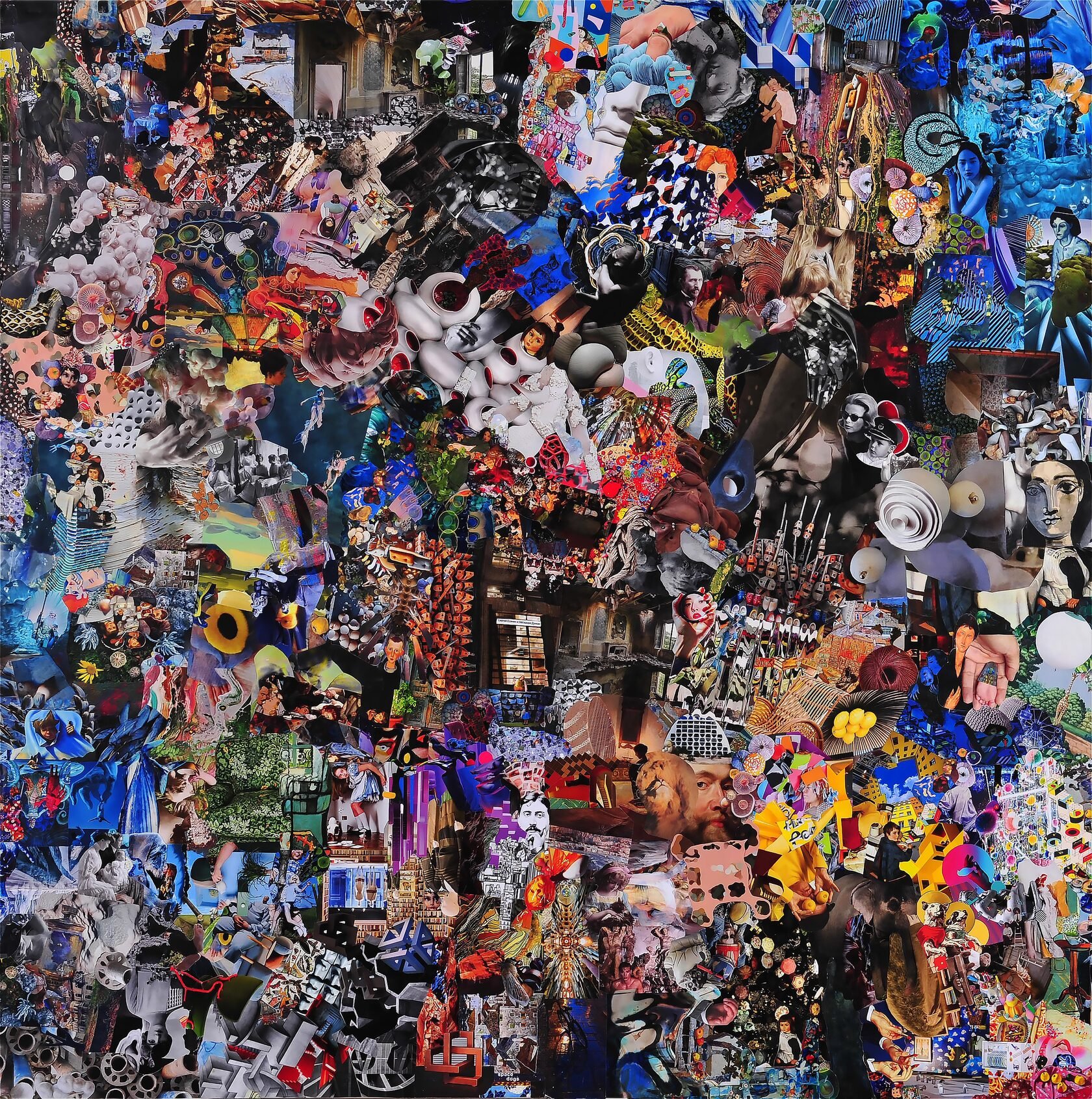
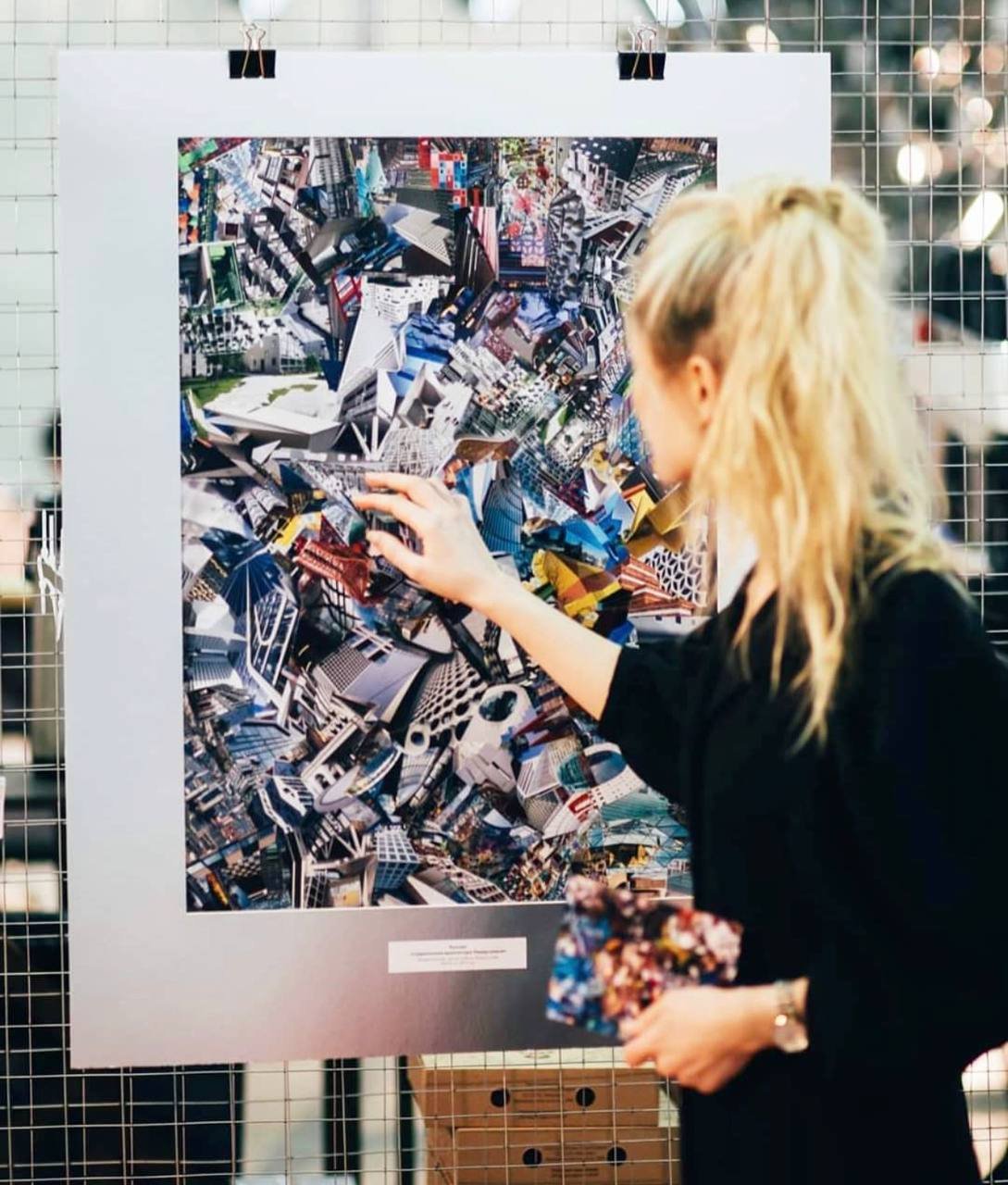
From a distance, my collages appear as abstract compositions of colour, rhythm and volume. To some, they may even seem chaotic. Move closer, and those abstract forms dissolve into hundreds of recognisable images, each connected through colour, shape and line. Step back again, and the image returns to abstraction. This constant shift between distance and detail is an essential part of my work.I never begin with a sketch or a finished composition. Every collage starts with a single visual connection. One colour leads to another, a line continues into the next, a shape finds its echo in another shape. Each connection determines the next, allowing the image to grow without a planned outcome.I work entirely by hand with paper and glue. Every fragment keeps its original scale and proportions, so instead of changing the material, I work with what already exists, searching for relationships between images.What fascinates me most is the moment when those individual relationships become something larger. No single fragment contains the final image, yet together they create forms that could never have been predicted at the beginning. At the same time, depth begins to emerge on its own through light and shadow, drawing the viewer deeper into the image and creating a surprising sense of volume. I don't design these structures - I discover them.Each series begins with a different visual theme-birds, architecture, dolls or other found imagery. The theme changes, but the method remains the same. Every new collection of images creates different relationships, different abstract forms, and new discoveries for both me and the viewer.
ANASTASIA IZOTOVA
Social Networks :
Instagram handle: @anastasia_collage
Portfolio: https://drive.google.com/file/d/19yMzzVkTqDXmQz1HCXoL93cUdC1qrfxr/view
Anastasia Izotova
1. Inspiration & Style
What initially inspired you to become an artist, and how did you develop your unique artistic style?
I have always been a creative person. My artistic background began in Moscow, where I spent eight years studying classical oil painting. Later, I moved to the Netherlands and completed a four-year Bachelor’s degree at KABK (Royal Academy of Art) in The Hague, specialising in interior architecture, furniture, and spatial design, and graduated with a Bachelor of Arts degree.
During my studies at the art academy, however, our work often went far beyond interiors and architecture. We were constantly encouraged to experiment, think conceptually, and explore different forms of creative expression. I had always loved to create artworks, and during this period I also became increasingly interested especially in collage.
Collage eventually became part of my graduation project, where I began developing the visual language that still defines my work today — the relationship between colour and form. At the time, I used this technique to explore the unconscious: how the mind works and what our inner, invisible processes might look like if they could take a visual form.
That project became an important turning point for me. I realised that art was more important to me than design — it gave me the freedom to explore ideas, emotions, and visual language in a much more personal way. From there, I decided to continue developing my artistic practice and the collage technique that had emerged during my studies.
2. Creative Process
Do you have any rituals or routines that help you get into a creative mindset when starting a new project?
Absolutely! My creative ritual usually starts with a cup of hot chocolate and complete immersion in my work. I normally begin around noon and continue for as long as I have the energy — every day is different. Sometimes I work until the evening, and sometimes I suddenly realise it is six in the morning.
In the background, I often play old films or lectures about art. They help me enter a certain creative atmosphere and stay there for hours. It feels almost like floating in a warm sea — a sea of ideas, images, and creative energy.
My process requires a great deal of concentration, so solitude is also an important part of my routine. I can only really work when I am alone in the room, completely focused and undisturbed.
3. Artistic Influences
How do you balance historical or artistic influences with your personal style, and how do these influences manifest in your work today?
My collage technique originally emerged from my research into how the human brain and our unconscious work. At the time, one of my sources of inspiration was MRI imagery of the brain in action. I was fascinated by the idea that incredibly complex, invisible processes could be visualised through colour, light, and form, and I wanted to find an artistic way to represent them.
Looking at these images, I began to see a strong correlation with abstract art. This is where my technique was born — a process through which abstraction emerges without the use of traditional painting. This distinction is important to me: I did not originally set out to create abstract art. My intention was to represent the processes of the brain artistically, and abstraction appeared naturally as a result.
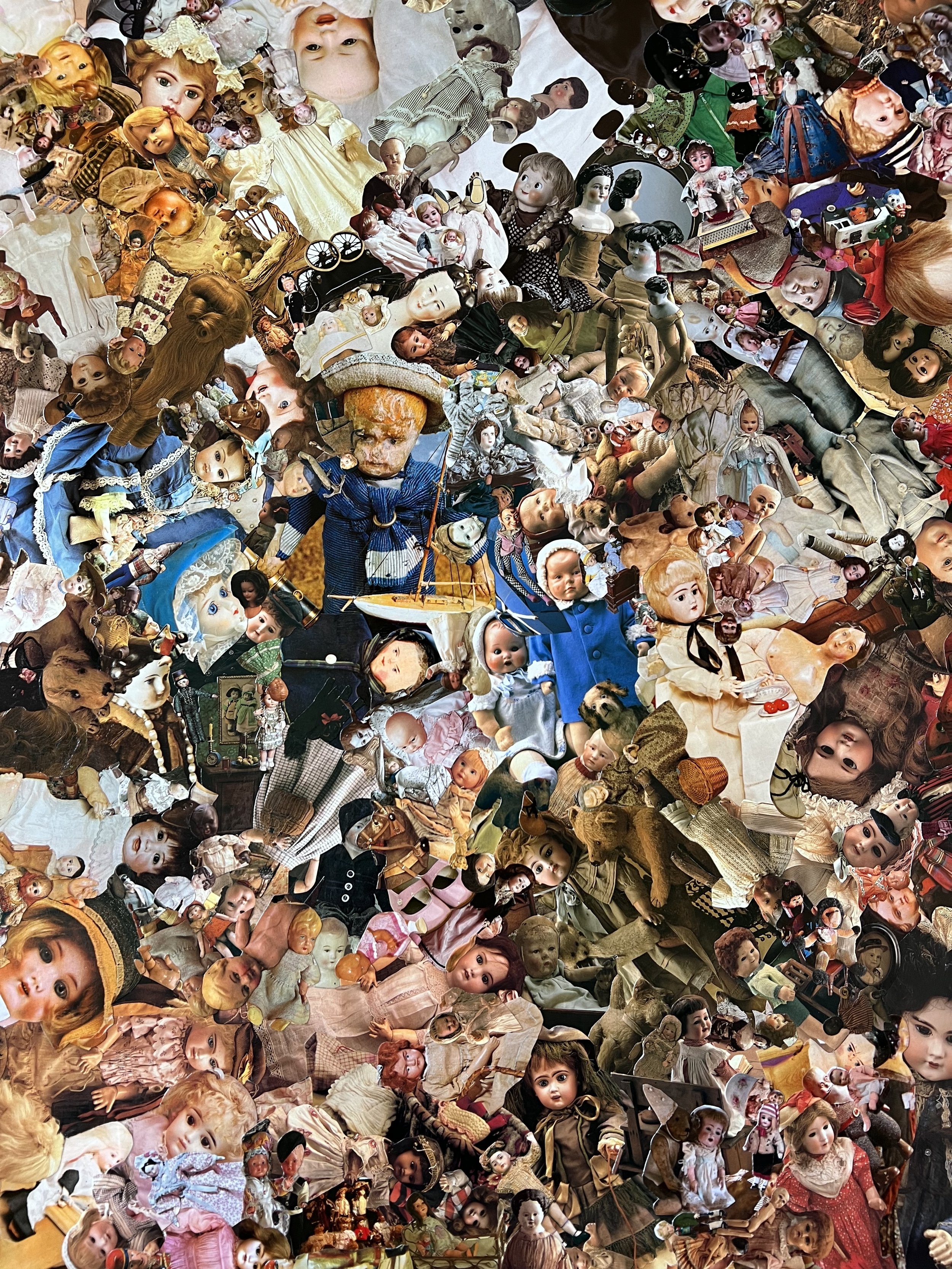
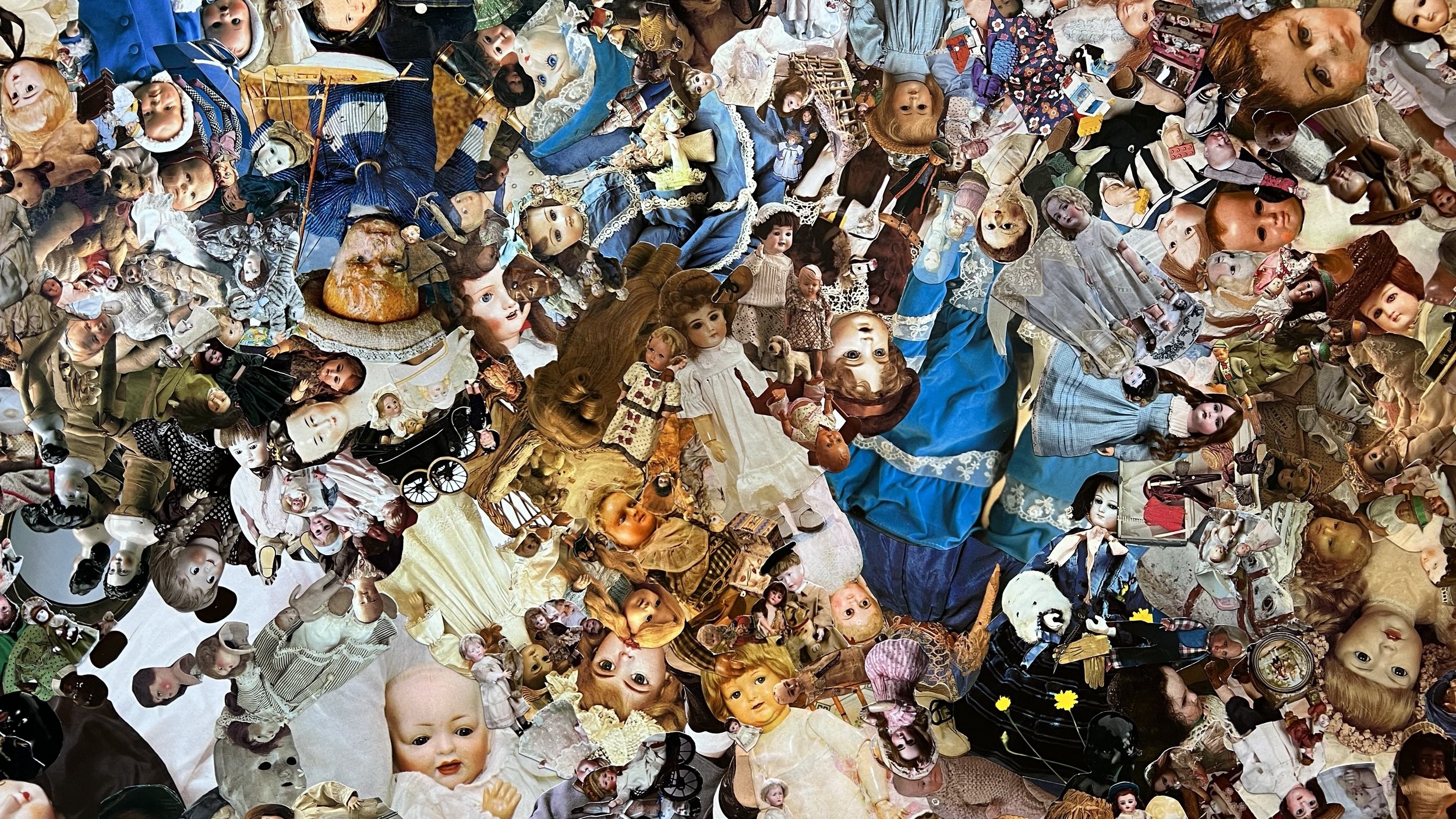
For me, it is important not to simply combine pieces of paper to produce a beautiful abstract composition. I always begin with a specific subject and explore its visual world. For example, if the subject is birds or dolls, I work with the colours, shapes, and visual elements that belong specifically to that subject and transform them into abstraction. Over time, this approach has developed into my own artistic method.
This is why I see each of my works as a visual investigation. Abstraction is not the final goal, but rather a way of seeing a familiar object or subject from an entirely different perspective.
4. Emotion & Expression
How do you use your art to evoke emotions, and what role does emotion play in your creative process?
The purpose of my art is not necessarily to evoke a particular emotion. I am much more interested in drawing the viewer into a visual investigation: What do you see? What catches your eye first? How does your gaze jump from one element to another and then suddenly discover something completely unexpected?
If there is one emotion that is particularly important to me, it is surprise — the feeling of an unexpected discovery. Everyone finds something different in my work. Sometimes people point out shapes or figures that I had never noticed myself, and I find that fascinating.
This is also why my works do not necessarily reveal themselves all at once. They can hang on a wall for years and continue to surprise you. Suddenly, your eye picks out a new silhouette, shape, or connection within all that visual complexity — something that seemed not to exist there before.
I think this is also connected to the way our unconscious mind works. It is never static: we are constantly accumulating new experiences, images, and memories. As we change, our perception changes with us. We begin to see more — and to see differently.
5. Standout Projects
Can you share a project that stands out to you and describe the creative process behind it?
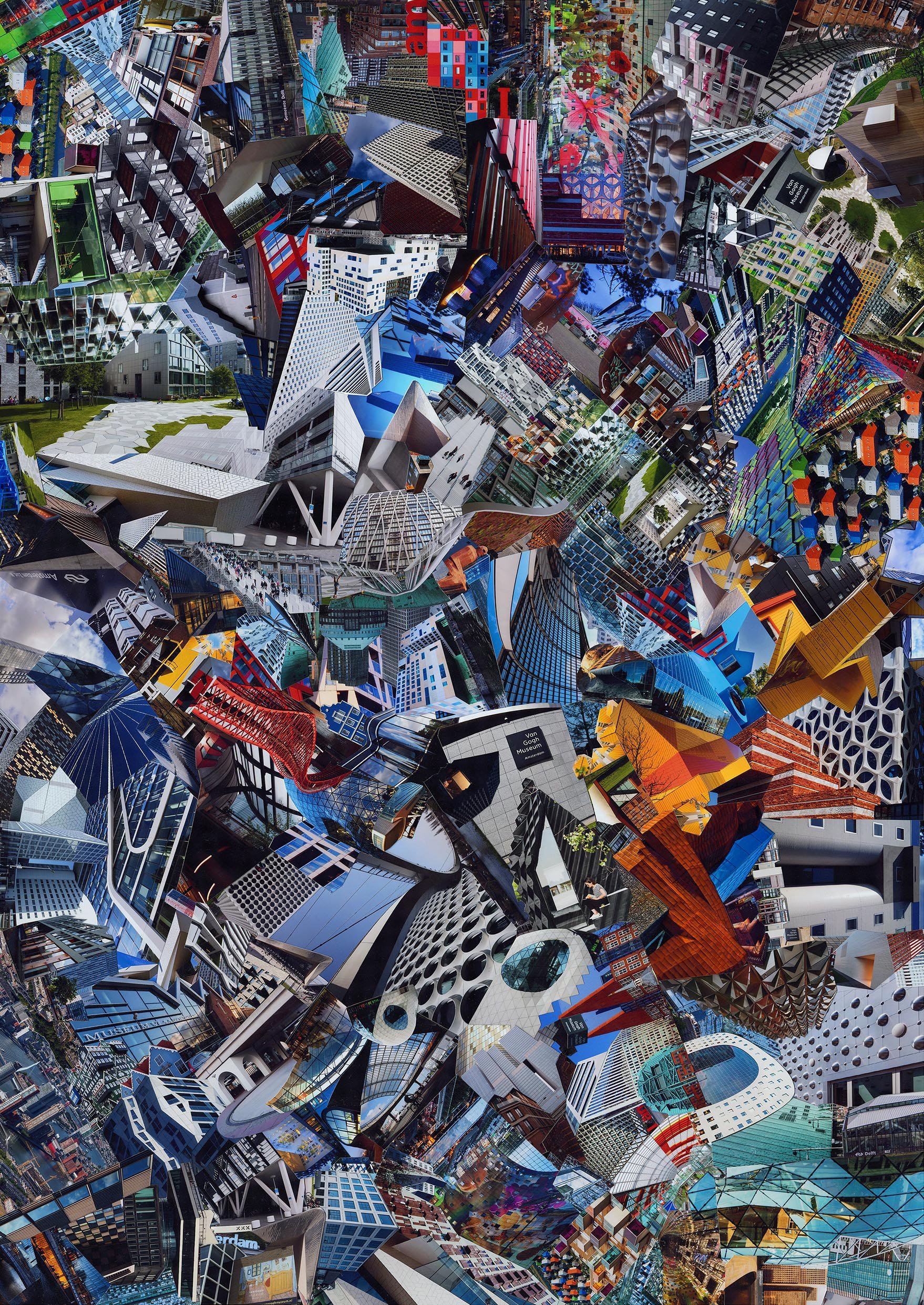
One project that particularly stands out to me is my 2019 collage Contemporary Dutch Architecture.
The idea was to explore contemporary architecture in the Netherlands through my collage technique. I collected images of different buildings and architectural details and brought them together into one composition, working with their existing shapes, colours, structures, and perspectives.
What surprised me most was the final result. I had never expected that when all these examples of contemporary Dutch architecture were brought together, the composition would become so sharp, spiky, cold and almost hedgehog-like.
I love this work because it is a perfect example of what fascinates me about my creative process: I begin with a specific subject, but I never fully know what visual character will emerge from it. In this case, the architecture itself created the abstraction — and the result surprised me as much as it might surprise the viewer.
6. Feedback & Growth
How do you incorporate feedback from critics or audiences into your work, and how do you balance this with your own artistic intuition?
Audience feedback often becomes part of my creative process, but perhaps not in the traditional sense. At exhibitions, people often suggest fascinating subjects for future works, and I actually write them down. What I value even more are the insights and philosophical conversations that my collages seem to provoke. I find it incredibly rewarding that the works can become such an open space for discussion and interpretation.
I especially love when someone points out something in one of my works that I have never noticed myself. It feels as if they are opening my eyes to something I have looked at many times but somehow never truly seen. Those moments give me a lot of creative energy and remind me that once a work is finished, it no longer belongs entirely to my own perception.
Of course, not all feedback is constructive. One of the comments that affected me most was someone saying that it must be nice to spend my time gluing thousands of pieces of paper together when my parents were paying for everything. By that point, I was already financially independent and working as a designer alongside my art practice, so the comment felt both presumptuous and dismissive.
What affects me most in negative criticism is not disagreement with my work, but the devaluation of the work behind it. My collages require an enormous amount of time,
concentration, patience, and persistence. I am always interested in how people interpret the work, even when their interpretation is completely different from mine, but I ultimately trust my own artistic intuition when it comes to what I create.
7. Motivation & Inspiration
How do you stay motivated and inspired, even when facing creative blocks or challenges? What motivates me most is knowing that my method is unique. It is something I developed myself, and no one else can create a work in exactly the same way.
Even when I experience a creative block or face difficulties, this thought keeps me going. I feel that I have found my own visual language, and there is still so much within it that I haven’t explored yet. There are countless subjects I can investigate through it, and I am always curious to discover what each new subject will become in my hands. That sense of having something that is truly my own is probably my strongest source of motivation.
8. Exhibiting Work
How do you feel about exhibiting your artwork with The Holy Art Gallery, and what does this opportunity mean to you?
I am very excited to exhibit my work with The Holy Art Gallery because, for me, this feels like an entry point into the Amsterdam art scene. It is my first step towards exhibiting my work in galleries here and becoming part of the local art community.
Amsterdam has been my home for several years, so it feels especially meaningful to finally begin presenting my art here. I see this opportunity as the beginning of a new chapter in my artistic journey, and I am very curious to see where it will lead.
9. Future Goals
What are your long-term goals and aspirations as an artist, and how do you plan to achieve them?
My long-term goal is to explore as many different subjects as possible through the collage technique I have developed and to make my own contribution to collage as an art form. I also deeply value working by hand. In an age of rapidly developing AI, I want to continue creating something meticulous and time-consuming with my own hands. For me, this process is also a way of drawing attention to how everything in our visual world is connected through colour and form — I see myself as assembling this enormous visual puzzle piece by piece.
In twenty or thirty years, I would like to look back and see a large body of work that demonstrates how far this technique can go and how many different ways it can evolve. My greatest aspiration is to become an artist recognised for bringing something distinctive and meaningful to the medium of collage.
10. Audience Connection
What do you hope viewers take away from experiencing your art, and how do you aim to connect with them on an emotional or intellectual level?
At first, I want them to see something that feels almost chaotic — a visual overload of colours, shapes, and fragments. But as they continue looking, I hope they begin to realise that nothing is random: everything is structured, connected, and related through colour and form.
I want the eye to travel through the work, finding familiar shapes, losing them, and suddenly discovering something new. There is no single correct interpretation — everyone sees something different and creates their own associations based on their experiences, memories, and unconscious mind.
This is where the connection with the viewer happens for me. I create a visual puzzle, but I don’t give instructions for how to solve it. The viewer gradually discovers that what first appeared to be chaos has its own structure and logic — and then finds their own way through it.