ARTIST STATEMENT
CYANOTYPE SERIES
BY
Carlita Scarboro-Vazquez
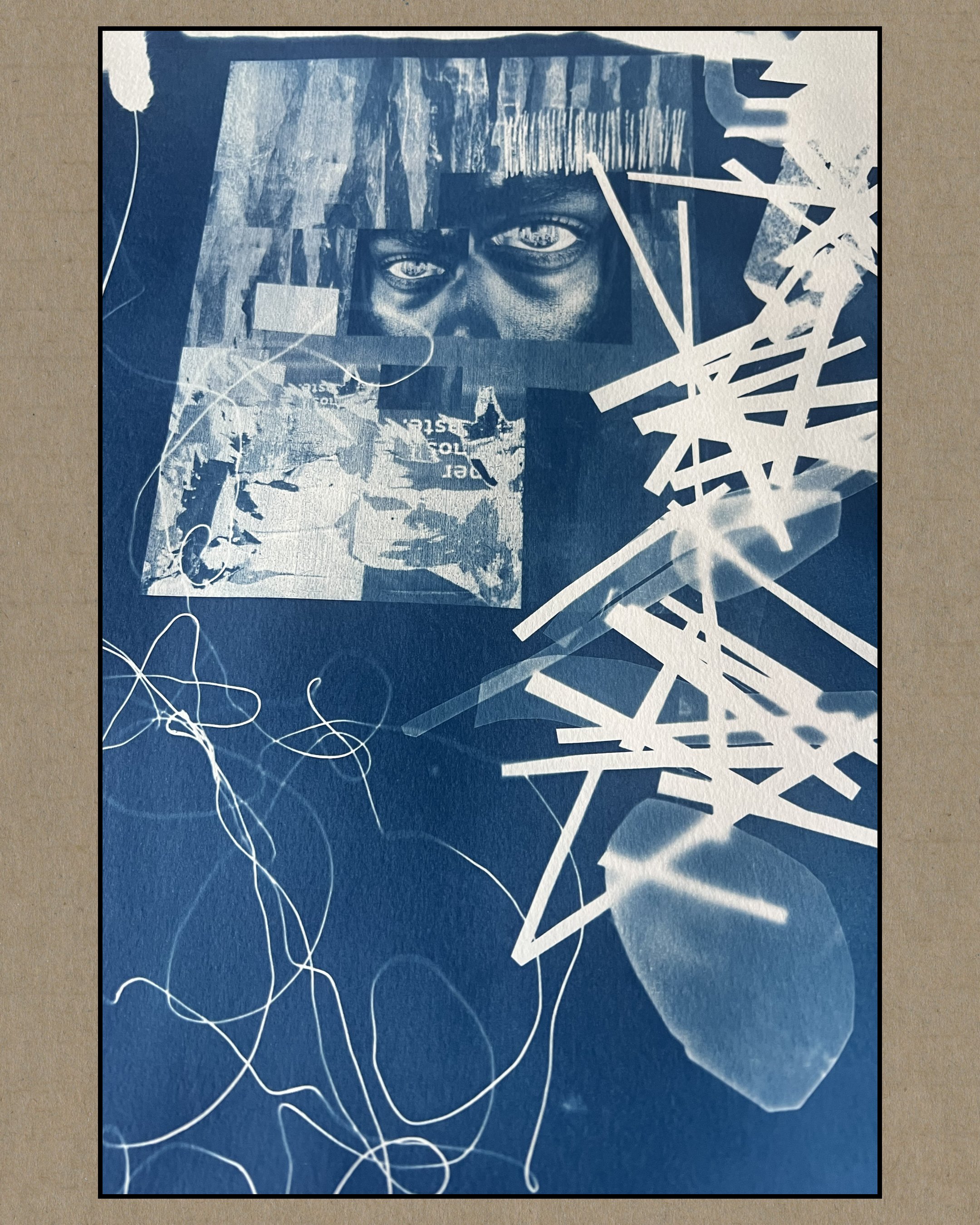
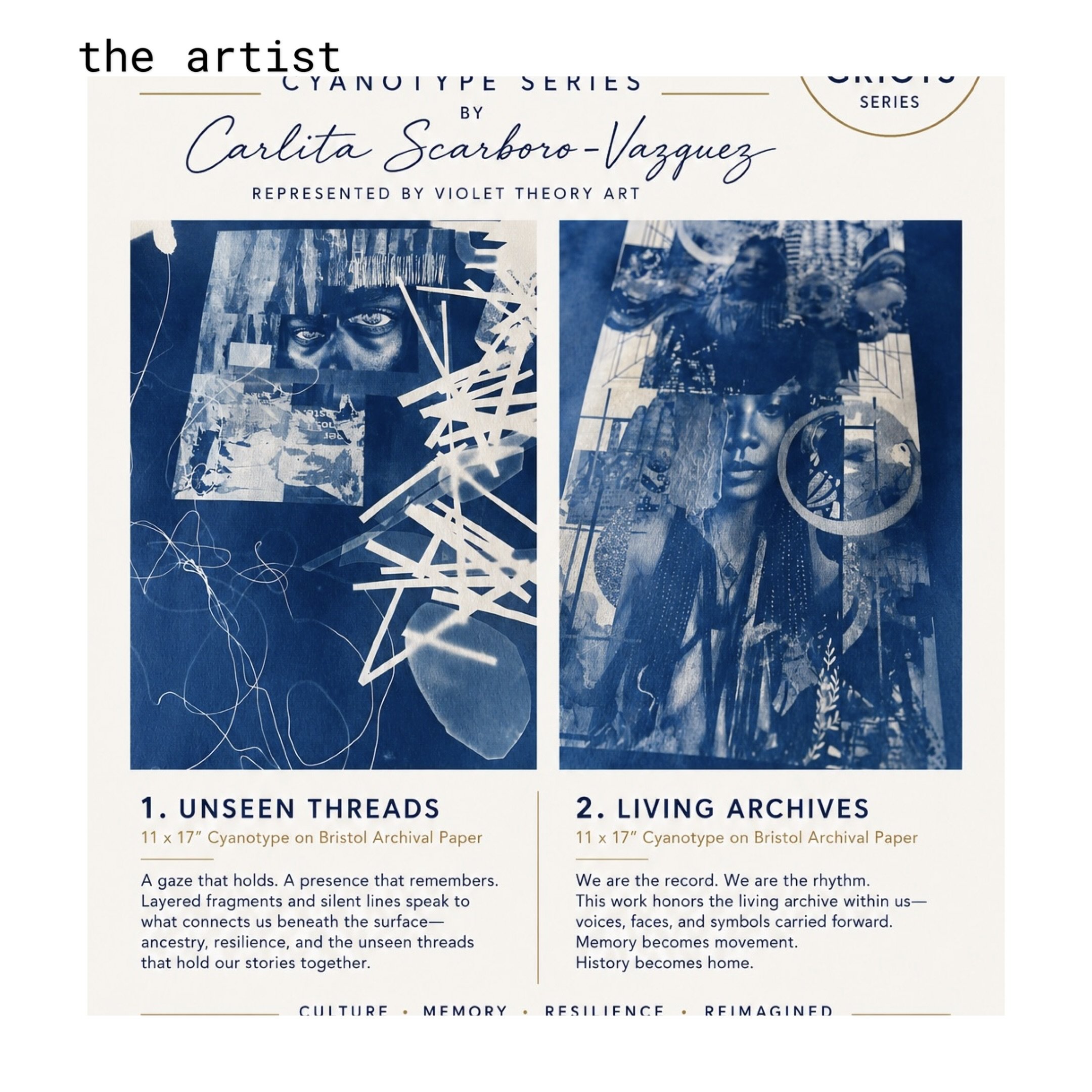
1. UNSEEN THREADS
11 x 17” Cyanotype on Bristol Archival Paper
A gaze that holds. A presence that remembers.
Layered fragments and silent lines speak to what connects us beneath the surface—ancestry, resilience, and the unseen threads that hold our stories together.
2. LIVING ARCHIVES
11 x 17” Cyanotype on Bristol Archival Paper
We are the record. We are the rhythm.
This work honors the living archive within us—voices, faces, and symbols carried forward.
Memory becomes movement.
History becomes home.
Social Networks :
Instagram: https://www.instagram.com/c_u_sunshine
1. Inspiration & Style
What initially inspired you to become an artist, and how did you develop your unique artistic style?
I have always understood art as a way of documenting experience—who we are, where we come from, and what we leave behind. My formal training at Howard University gave me permission to experiment across disciplines rather than define myself by one medium. Over time, my practice developed into a layered visual language combining photography, digital manipulation, cyanotype, textiles, found materials, collage, projection, and mixed media. I am especially interested in the Black figure, memory, identity, cultural inheritance, and the ways traditional processes can exist alongside technology. My style has evolved through experimentation: layering, removing, obscuring, reconstructing, and allowing the history of the process to remain visible in the finished work.
2. Creative Process
Do you have any rituals or routines that help you get into a creative mindset when starting a new project?
My process usually begins with a question rather than an image. I research, collect photographs, fabrics, objects, textures, historical references, and fragments of stories. From there, I begin experimenting without being overly concerned with the final outcome. I might digitally manipulate an image, print it as a cyanotype, distress a surface, introduce fabric or thread, project onto it, or photograph it again. I enjoy moving back and forth between analog and digital processes. My studio becomes a laboratory where one experiment informs the next. I also leave room for accidents because some of the strongest visual discoveries happen when the material does something I did not plan.
3. Artistic Influences
How do you balance historical or artistic influences with your personal style, and how do these influences manifest in your work today?
History is a foundation in my work, but I am not interested in simply recreating it. I look at African and African American visual traditions, textiles, quilting, photography, portraiture, abstraction, architecture, Japanese concepts such as boro and wabi-sabi, and contemporary digital culture. I am drawn to traditions where objects carry evidence of time, labor, repair, migration, and human touch. I bring those references into conversation with my own experiences and contemporary technologies. The result becomes less about reproducing a historical aesthetic and more about asking how memory can be reconstructed for the present.
4. Emotion & Expression
How do you use your art to evoke emotions, and what role does emotion play in your creative process?
Emotion often exists in my work through what is partially revealed and partially concealed. A face may be fragmented, layered with patterns, interrupted by marks, or embedded within another image. I want the viewer to slow down and search. There is often tension between visibility and invisibility, strength and vulnerability, beauty and disruption. Blue has also become an important emotional language in my cyanotype work—it can suggest history, spirituality, distance, melancholy, water, sky, and possibility simultaneously. Rather than telling viewers exactly what to feel, I create space for them to bring their own memories into the work.
5. Standout Projects
Can you share a project that stands out to you and describe the creative process behind it?
My evolving cyanotype and mixed-media body of work stands out because it brings together many parts of my practice. I begin with photographic imagery and digitally reconstruct it through layering, repetition, fragmentation, and abstraction. Those images are then translated through cyanotype, where sunlight, chemistry, water, and time become collaborators in the process. I may continue altering the resulting surface with textiles, stitching, collage, projection, or other materials. Recent collaborations have also allowed these images to move beyond the wall and into wearable and functional forms. That expansion is important to me because I am interested in what happens when art moves from an object we observe into something we inhabit, wear, encounter, and live with.
6. Feedback & Growth
How do you incorporate feedback from critics or audiences into your work, and how do you balance this with your own artistic intuition?
I listen carefully to feedback, particularly when someone identifies something in the work that I did not consciously recognize. Those conversations can reveal patterns and connections that help me understand my own practice more deeply. At the same time, I have learned that feedback is information, not instruction. I consider it, but I return to the original intention of the work and trust my instincts. Growth comes from remaining open without allowing every outside opinion to redirect the work.
7. Motivation & Inspiration
How do you stay motivated and inspired, even when facing creative blocks or challenges?
I stay curious. When one medium becomes difficult, I move to another. I might stop working on an image and experiment with fabric, build an object, photograph something, work with projection, visit an exhibition, or simply research. Teaching engineering and technology also influences the way I think as an artist. The Engineering Design Process—questioning, researching, prototyping, testing, evaluating, and redesigning—has parallels to my studio practice. A creative block can therefore become a design problem rather than a stopping point. I give myself permission to experiment without requiring every experiment to become finished artwork.
8. Exhibiting Work
How do you feel about exhibiting your artwork with The Holy Art Gallery, and what does this opportunity mean to you?
Exhibiting with The Holy Art Gallery represents an opportunity for my work to enter a broader international conversation. I am interested in what happens when artwork rooted in my experiences and cultural perspective encounters audiences in different places and contexts. Every exhibition creates a new relationship between the artwork, the space, and the viewer. I value opportunities that allow the work to travel beyond my immediate community while still carrying the histories and stories from which it emerged. It is exciting to have The Holy Art Gallery provide another platform for that exchange.
9. Future Goals
What are your long-term goals and aspirations as an artist, and how do you plan to achieve them?
My long-term goal is to continue expanding my practice beyond traditional boundaries between fine art, technology, design, fashion, installation, and public engagement. I want to create increasingly immersive work incorporating cyanotype, textiles, sculpture, projection, sound, and digital technologies while continuing to exhibit nationally and internationally. Collaboration is also central to that vision. I want to work with designers, technologists, cultural practitioners, and other artists to explore what becomes possible when disciplines intersect. Ultimately, I am interested in building a sustainable practice that allows me to create ambitious work, contribute to cultural conversations, mentor emerging creatives, and leave behind a meaningful body of work.
10. Audience Connection
What do you hope viewers take away from experiencing your art, and how do you aim to connect with them on an emotional or intellectual level?
I hope viewers first give themselves permission to experience the work before trying to explain it. I want them to move closer, notice the layers, discover something they initially missed, and perhaps recognize pieces of their own history within mine. My work often deals with memory, identity, visibility, transformation, and legacy—ideas that are personal but also universal. I am particularly interested in the question of what we preserve, what we inherit, and what we choose to carry forward. If someone leaves the work thinking about their own family, culture, memories, identity, or place within a larger history, then the artwork has created the kind of connection I am seeking. For me, art does not have to provide the answer. Sometimes its greatest power is creating the space for us to ask a better question.